
Bird Cages

DISCLAIMER: This is a bit of a different post than what I usually write. This is this first in a series that I intend to write about mind and behavior, how we relate to ourselves and the world around us, and ultimately, what we dare to believe is possible. Part philosophy, part psychoanalytic musing, part integrative writing for my own sake - I hope you enjoy this type of writing as much as I do.
I once told a friend that we construct bird cages for ourselves out of beliefs, trapping our Self inside.
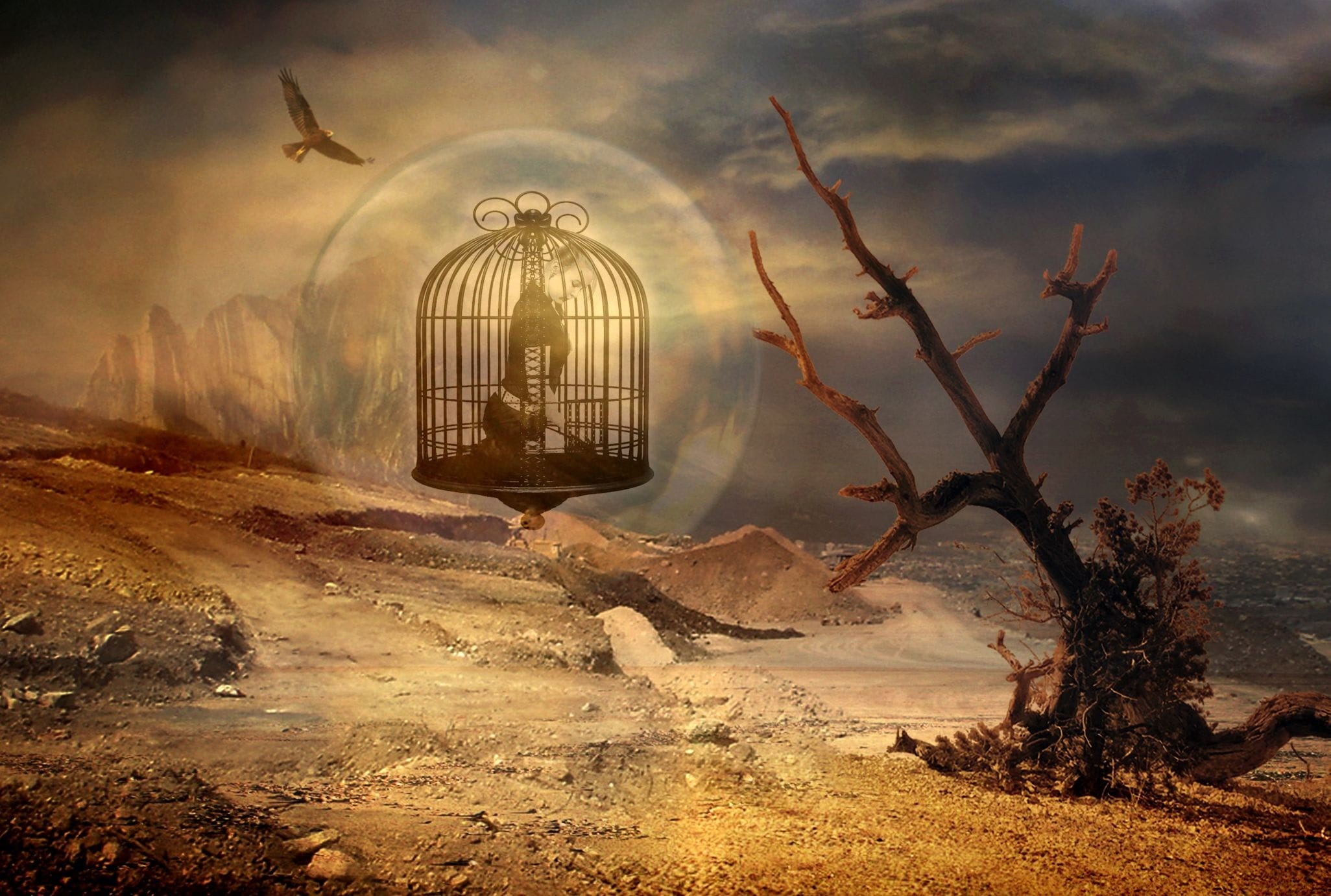
You take one slender belief and tie it to another, then another, then another, weaving a nice cage for the Self. You fabricate the bars from imputed beliefs about the world, our emotions, and ourselves. These cages make you feel safe by simultaneously limiting what you can literally see and experience while also preventing you from having to extend your thoughts to accommodate new data that doesn’t fit inside the cage.
The cage is also, of course, a mirage. You can fly out anytime you want.
But you don’t.
It is much easier to keep weaving the cage tighter and tighter until one of two things happens.
You feel you cannot breathe and break the cage to move to a “higher stage of development”, where you rinse and repeat this process - it’s like Campbell’s Hero’s Journey (more on this later) but more masochistic as you don’t freely engage in it.
You stay unhappy and stunted, unable to break free of the cage you so artfully wove for yourself, thinking that the bars would make you safe and not have to worry about the world “out there”. Unfortunately, the world out there is already inside the cage.
There is a third option, which is to step outside the cage and spread your wings and fucking fly like you are supposed to. But that requires knowledge of flight and the confidence to venture into the unknown and once you do, (here is the critical part), you never get to come home.
COVID and the Hero’s Journey to Nowhere
Before we talk about Option Three, I want to touch on something that many people seem to have forgotten, even in the circles where folks believe in theories like Jung’s collective unconscious or vibrational waves or karmic knots: COVID-19. This is a recurring theme for me, and came up recently in a psychoanalysis session when I half-jokingly quipped, “I think I relate all my issues back to COVID now.”
As well I should. COVID was and is paradigmatically defining - evidenced as much as our refusal to acknowledge it happened (“Oh yeah I keep forgetting that even happened - I feel like that was a different life!” one of my friend’s told me recently) as by the concrete wall that it erected in so many peoples’ lives. My stories aren’t unique, but I’m sure you know them: lives put on hold, plans for the future shattered and dashed, college experiences ruined, confinement to your parents’ house, a mistrust of strangers, and over 18 million people dead.
COVID threw a collective wrench at our heads, the world screaming “wake up people!” and we all hated it so much that as soon as the vaccine became widely available we tried to go back to normal. Myself included. Every person’s individuated bird cage became super-charged during COVID - in other words, we all ossified into stale, brittle versions of ourselves. Ostensibly, COVID is over, but I feel its presence more viciously now than I did even during high of the pandemic. The pandemic is gone, but the behaviors and backlash wrought by it seeped into every pore of everyone I know.
We tried to return to normal, clinging to our bird cages even as the world burns and falls apart around us, but we failed to recognize that there is such a thing as a normal to return to.
“Oh yeah I keep forgetting that even happened - I feel like that was a different life!”
Enter Joseph Campbell’s The Hero’s Journey. Here it is, as defined by the big man himself:
“The mythological hero, setting forth from his common-day hut or castle, is lured, carried away, or else voluntarily proceeds, to the threshold of adventure. There he encounters a shadow presence that guards the passage. The hero may defeat or conciliate this power and go alive into the kingdom of the dark (brother-battle, dragon-battle; offering, charm), or be slain by the opponent and descend in death (dismemberment, crucifixion). Beyond the threshold, then, the hero journeys through a world of unfamiliar yet strangely intimate forces, some of which severely threaten him (tests), some of which give magical aid (helpers). When he arrives at the nadir of the mythological round, he undergoes a supreme ordeal and gains his reward. The triumph may be represented as the hero’s sexual union with the goddess-mother of the world (sacred marriage), his recognition by the father-creator (father atonement), his own divinization (apotheosis), or again — if the powers have remained unfriendly to him — his theft of the boon he came to gain (bride-theft, fire-theft); intrinsically it is an expansion of consciousness and therewith of being (illumination, transfiguration, freedom). The final work is that of the return. If the powers have blessed the hero, he now sets forth under their protection (emissary); if not, he flees and is pursued (transformation flight, obstacle flight). At the return threshold the transcendental powers must remain behind; the hero re-emerges from the kingdom of dread (return, resurrection). The boon that he brings restores the world (elixir).”
I’m not about to get into an argument with Joseph Campbell. I find the Hero’s Journey outline compelling, especially as it consists of three crucial points:
Separation/departure: “setting forth from his common-day hut or castle, is lured, carried away, or else voluntarily proceeds, to the threshold of adventure.”
Initiation: “Beyond the threshold, then, the hero journeys through a world of unfamiliar yet strangely intimate forces….When he arrives at the nadir of the mythological round, he undergoes a supreme ordeal and gains his reward.”
Return: “The final work is that of the return…. At the return threshold the transcendental powers must remain behind; the hero re-emerges from the kingdom of dread…. The boon that he brings restores the world (elixir).”
Campbell’s work is, in it’s own right, generationally defining. It greatly influenced the work of George Lucas on Star Wars, which is embraced by a nearly two-thirds of American’s according to YouGov. The hero’s journey is also visibly on display in almost every major TV show or block-buster success with wide appeal, from Lord of the Rings to Friends to Shrek to Game of Thrones to Marvel to {insert name of super-popular franchise}.
Our modern-day myths are, tragically, more misleading than the myths which Campbell based his work on. I find the last sentence telling when thinking of ‘Retur’n in this classical sense:
“The boon that he [the Hero] brings restores the world”.
Rare indeed is the Hero who succeeds to save the world for himself - he usually saves the world for other people:
Theseus defeats the Minotaur and returns to Athens triumphant, only for his father to commit suicide.
Prometheus steals fire from the Gods and gives it to humanity, only to be chained to a rock and have his liver ripped out over and over again.
In the Haida myth, Raven Steals the Light, Raven is chased beyond the world by Eagle before finally letting go the last of the light.
For Sun Wu Kong, the Monkey King, achieves enlightenment at the cost of everything he once held dear - his family, friends, and kingdom.
Today, however, the Hero happily returns home, having defeated the bad guy, saved the princess, toppled the empire, and lives happily ever after. This is rarely the case for any of us, and as anyone who has truly undergone a hero’s journey understands (which should be all of you), you “return” not to the world you left, but to an alien place where your friends speak strange tongues and you don’t recognize your own home. And how do you adapt? By building yourself a cage so you don’t have to go on anymore adventures.
As noted above, you usually either end up shattering the cage - often through a quarter-, mid-, or retirement- life crisis - once you cannot stand to be trapped any longer. It results in a hero’s journey of a sort, but one that you tortuously engage in because you feel like you have no other choice. It’s that or stay trapped. And at the end, of course, you don’t get to return to normal anyway because the Return is not for the self that left. You can’t go back to a place that doesn’t exist anymore.
I find this stutter-step cycle, of limiting self belief (the Bird Cage) to a hero’s journey of survival to a new Cage crafted from old and new beliefs that makes a facsimile of the world we once knew, defining for our modern era. So many people I know - myself foremost among them - are terrified of starting a new life after the Return. So we have a lurch-step process of semi-development, resulting in Ego’s that cling to a better past than the present, stunting their own growth. It is this unconscious refusal to develop that Robert Moore and Douglas Gillette speak to in “King, Warrior, Magician, Lover” when they discuss the chronic underdevelopment of the Western male psyche that patriarchal systems engender.
You can’t go back to a place that doesn’t exist anymore.
Time to talk about the elephant in the room. COVID-19 brought our stutter-step cycle, such as it is, to a screeching halt. Even generative hero’s journeys engaged in willingly were halted in their tracks. The result? Our band of heroes - me, you, everyone in the world, etc. - more or less got to “the threshold of adventure” and were not able to cross. To not cross that threshold of adventure and undergo the rites of initiation when you are on your way is psychically scarring.
These patterns of behavior are deeply etched into our minds, requiring time and energy to heal and undergo. Once you embark on the hero’s journey, you finish it, or become a wandering lost soul at best. I speak now from my own experience, planning to launch into my mid-20s, and instead coming up agains the iron wall of the pandemic, working a job I didn’t want to make ends meet in a life that I didn’t choose in a country that felt (and feels) like it was falling apart. Life, however, flowed onwards. There is no time-turner here to try and recapture those years of pain, stagnation, and inward-facing humiliation, just a desperate clawed hand holding on to the gunwale of life as it cut through midnight and unknown waters until the sun rose again: the mRNA vaccine. It heralded a communal and global “Return to normal” - such hubris and pride, to go through a paradigmatic shift like a global pandemic and pretend that we could Return to normal, not recognizing that normal was already dead and gone two weeks into stopping the spread.
But should we really be so surprised? That pattern of behavior is exactly the same as in our individual lives. The 21st century global Hero’s Journey through COVID mirrors our individual Hero’s Journey. Jung’s ‘collective unconscious’ is very much at work here - the collective relief at getting to (pretend) to go back to normal was physically palpable. The summer after the vaccine was like living life on drugs…and the time since then I spent re-weaving my safe little bird cage of beliefs, incorporating new ones to complement the old ones, sitting and waiting for my grand Adventure to begin, forgetting I am already on the path back to nowhere.
Mama, I’m (Never) Coming Home
So yeah, this is a real bummer of a post. Let me be the first to acknowledge that.
The good news is, you aren’t a bird stuck in a cage. We all have agency in our lives but rarely use it. I don’t have a solution for you, unfortunately, as that is something you need to arrive at on your own. However, I do have some thoughts on where you might start. First, stop pretending to be an ostrich. Acknowledge the pain and suffering that the pandemic caused you (maybe you’re already doing this, if so, hell fucking yeah) and how you have changed your life to adapt to that stunting of growth. For me, this required professional help from a therapist, but you may just as easily get help from a trusted mentor, a life coach, or even a close friend you look up to.
Simultaneously, you can start to spread those wings and learn to fly. The antidote to self-imposed misery is self-imposed joy. Start by doing the things you love. For me, it’s writing, dancing, traveling, exercise, and being in nature. Then, like all wings, you need to grow your strength. Go to unfamiliar places and talk to unfamiliar people - expose yourself to other ways of being and other ways of life. Consider that you might be wrong. This practice led me to realize that what I actually wanted in life wasn’t what I was doing. So (and this is where I am in the process) I am making some shifts to go back to school to study psychoanalysis and to go into therapy.
Finally, acknowledge that you will not return to your old life, and embrace that truth. There is no going back to normal (if there was any normal in the first place) to the way things were, but there is a way forward. We all have lives to live and the operative word there is live. I know for myself, most of the past 5 years feel dreamlike and unreal - like I haven’t actually been awake or alive, but in a limbo state, half alive half dead. So, I’ve resolved to try and start living a little more of life’s joys and pains, to truly feel and live my life from a place of meaning.
I hope this writing, in some small way, inspires you to do the same.
Keeping my feet on the ground and my head in the clouds - Nico