
2. Inanna
Stripped to the Bone

“The privilege of a lifetime is being who you are.” — Joseph Campbell, The Power of Myth
Welcome! This is the Thousand Faces Project, where I share myths from the “Thousand Faces” of the Hero-Myth (Joseph Campbell’s monomyth), drawing on tales and legends from around the world. Some of these myths may fall outside or around Campbell’s work. I’m not too fussed about it.
Each post follows a similar structure:
Contemplation - a couple questions for contemplation as you go about your day.
Myth - the largest section, a simple retelling of the myth.
Discussion - my thoughts on contextualizing the myth for modern times.
I am fussed about accuracy - so if you see an inaccuracy in my sketch of the myth - I beg of you to message me so I can fix it pronto.
Alright, with out further ado, here’s today’s myth:
Contemplation:
What parts of yourself do you need to surrender in order to grow?
When was the last time you sat with a version of yourself you’d rather not acknowledge: the jealous one, the grieving one, the one who’s angry for no good reason?
If you’ve ever felt like your brain won’t let you perform the “normal” version of yourself (the put-together, executive-functioning, on-time version) what did stripping away that mask reveal underneath?
Myth - The Descent of Inanna:
Around 1900 BCE, give or take a few centuries, Sumerian scribes pressed Inanna’s Descent to the Underworld into wet clay. One of the oldest recorded narratives in human history, and arguably the first hero’s journey we have on tablet (certainly millenia before you could buy tik-tok slop on the iPad Pro).
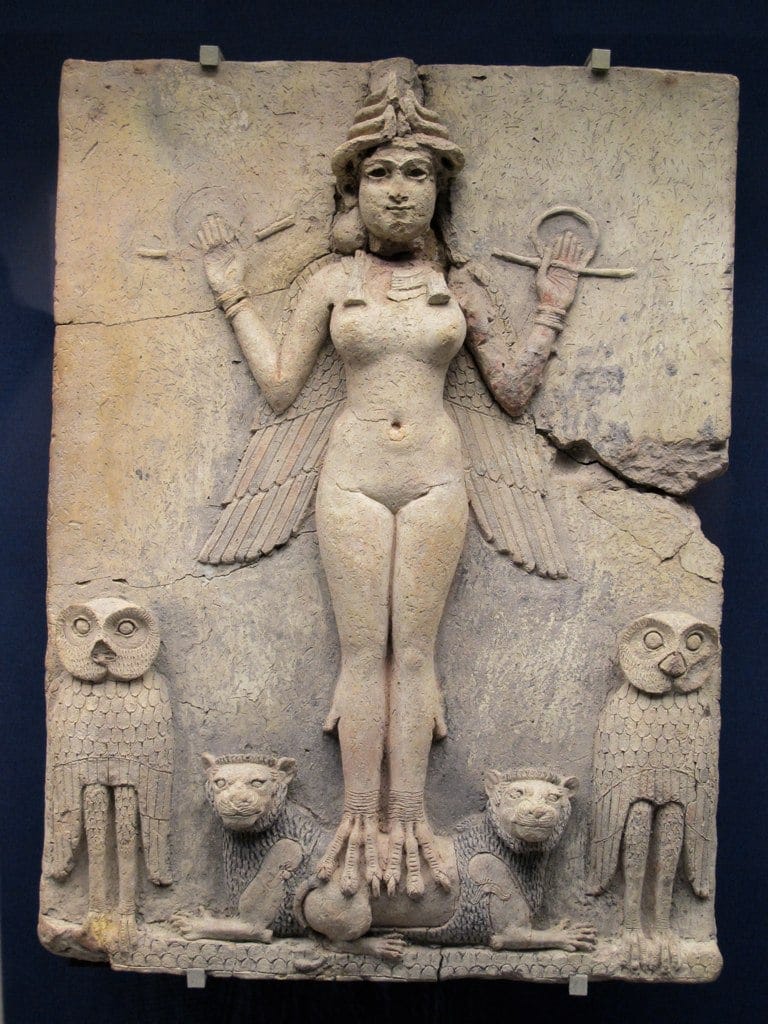
Inanna is the Queen of Heaven and Earth, and her’s is the domain of love, war, fertility, and political power. She is everything that makes life worth living and simultaneously terrifying. Our passion, our anger, our desire all come from Inanna. And she decides to leave her world - our world - to visit the Great Below: the land of the dead, ruled by her sister Ereshkigal.
What’s wild here is that there is no prophecy, no quest, no wise old man handing her a sword. She just... goes. In fact, the poem opens with the lines:
From the "great heaven" she has set her mind on the "great below" / … / Inanna has abandoned heaven, abandoned earth, and is descending to the underworld.
She adorns herself with seven powers (in the text, they are actually called “me’s”): her crown, her lapis lazuli necklace, her double strand of stones, her breastplate, her royal pala dress, golden ring, and her lapis lazuli measuring rod and line - and then tells her minister Ninshubur: “If I’m not back in three days, raise hell with the other gods.” (my paraphrasing). She especially tells her to entreat Enki, the lord of great wisdom, foretelling that he will restore her to life.
And she goes to the gates of the underworld, only to find them barred to her passage on Ereshkigal’s orders. At each of the seven gates of the underworld, the gatekeeper stops her, and strips away one piece of her regalia at each gate: first, the measuring rod and line. Second, her crown. Third, her lapis lazuli necklace. Fourth, her double strand of beads. Fifth, her breastplate. Sixth, her gold ring. Seventh, her royal pala dress.
At each of the seven gates she protests, and at each gate the gatekeeper responds:
Be satisfied, Inanna. You must not open your mouth against the sacred customs of the underworld.
Remember, each item is a symbol of her power and identity. Their removal allows her to be “subjugated”, and Ereshkigal then rises from her throne, only for Inanna to sit herself upon her sister’s throne. The Anunnaki, the seven judges of the underworld, then “looked at her with the look of death /spoke to her with the speech of anger / shouted at her with the shout of guilt” and Inanna is killed outright. Her corpse is hung on a hook on the wall like a slab of meat.
After three days, Ninshubur does raise hell, catching the notice of Enki, while the other gods shake their heads and lament:
The powers (me’s) of the underworld are powers (me’s) which are not to be coveted, for whoever gets them must remain in the underworld.
But Enki sends two small beings are sent to the underworld with the food and water of life. They find Ereshkigal in agony - groaning, in labor, grieving. They mirror her pain back to her. They say, “You are in pain.” That’s it. And in her gratitude, she releases Inanna, allowing the messengers of Enki to restore her to life.
But Inanna doesn’t escape cleanly. The Anunnaki sieze her and demand a replacement, as no one has ever returned alive from the underworld. She returns from the dead with seven demons as her guards as she searches for a replacement. She doesn’t have far to search, as she finds her husband Dumuzi the shepherd sitting on her throne, dressed in his finest, apparently not mourning at all.
Enraged, she orders the demons to take him, aaand Dumuzi hightails it out of there. Eventually he is caught along with his sister, and Inanna sentences Dumuzi to spend half the year in the underworld and his sister the other half.
Discussion
There’s something almost offensively pertinent about a myth from four thousand years ago that opens with a woman who has everything choosing to walk straight into the worst place imaginable. Indeed, the narrator even judges her, showing that she “abandoned” her sacred places: Inanna has abandoned Heaven and abandoned Earth because she set her mind on the "Great Below”.
In Campbell’s formula, this COULD be seen as the call to adventure, but it’s a peculiar version. Nobody calls Inanna. There’s no burning bush, no refusal of the call, no mentor figure. She just knows. Something in the Great Below is hers, and she can’t be whole without it. Indeed, she actually bucks the hero’s journey - which is a good thing, because the hero’s journey doesn’t always come from an external challenge. Sometimes, we actually have an impulse, a dissatisfaction with the way things are even if we seem to have it all (just look at Siddartha Gautama - raised a prince, left it all behind because he knew there must be more). The feeling, the one that says your normal life isn’t enough, and you know it, is one of the most dangerous and necessary forces in the human psyche.
Jung would call what Inanna meets in the underworld the Shadow. Ereshkigal is everything Inanna is not. Where Inanna is radiant and powerful and desired, Ereshkigal is isolated, grieving, raging in the dark. She is the abandoned twin, the sister no one visits, the part of ourselves we’ve exiled to keep the surface looking good. And she is furious about it. Jung wrote in Aion that “the shadow is a moral problem that challenges the whole ego-personality, for no one can become conscious of the shadow without considerable moral effort.”
Inanna’s descent is that moral effort - at each gate she is beaten down and instructed to be satisfied (or be quiet, another translation) and that she must obey the customs of the underworld. Every piece of identity that Inanna carries connects with her power - her “me’s”, or in other words, her Ego - and every piece is systematically cut away while she proceeds to meet her sister.
First, the measuring rod and line = the ability to judge
Second, her crown = regal authority, her divine mandate
Third, her lapis lazuli necklace = charm and beauty
Fourth, her double strand of beads = her fertility
Fifth, her breastplate = protection AND sexuality - the breastplate is called the “look at a man and he gives in” in the poem.
Sixth, her gold ring = power over connections
Seventh, her royal pala dress = her status as a god, as royalty
Stripped of who she is, Inanna is subjugated, leaving…not-Inanna. This not-Inanna is now empty - and into that emptiness she takes the me’s (powers) of the underworld as she sits upon Ereshkigal’s throne.
For a moment, before the Anunnaki kill her (we’ll get to that).
If you’ve ever been through a real crisis — a divorce, the death of a parent or a child or a best-friend, a total breakdown, a spiritual emergency, the kind of loss that truly empties you out — you’ve been through the seven gates. And if you’ve got ADHD or any flavor of neurodivergence, you might know a subtler version: the slow, grinding realization that the masks you’ve built to pass as “normal” are killing you, and at some point you have to let them drop. Your Shadow doesn’t care about your coping strategies. It doesn’t care about your workarounds. It wants you, the raw and undefended version, or it gives you nothing.
Buddhist psychology maps onto this with startling precision. The stripping of the me, the constructed identity, the aggregates we mistake for a self, is central to the path. One of the first examinations one undertakes in the Madhyamika reasonings is to understand the selflessness of self - that the imputed self reading this paper is not truly there, it only appears to be so. Inanna’s descent is a mythological enactment of exactly that process: the systematic dismantling of everything she thinks she is, so she can meet what actually is.
The difference is that Inanna doesn’t go willingly into equanimity. She goes kicking, questioning and protesting at every gate - which, if you’ve ever sat down to meditate and got distracted, is exactly what our mind does.
So what about when Ereshkigal and the Anunnaki kill her? How does that fit into this transcendental moment?
Quite simply: actions have consequences.
The price Inanna is willing to pay is with her life. She knows this when she goes in, hence her instructions to Ninshubur. This is part of the “moral effort” Jung speaks about: to change ourselves, we have to endure the consequences. This might be the loss of a friend (or multiple friends), getting fired, or other unintended side effects. The Buddhists call this a quickening of karma, that is, the seeds of your past actions come to fruition more quickly when you start to take your own path more seriously. The good news is what comes after: resurrection.
And HOW resurrection happens here is fantastic. The two small beings sent to rescue Inanna from Enki don’t fight the queen of the dead. They don’t trick her. They witness her with compassion. She groans, and they say, “You are in pain.” She cries out, and they say, “You are suffering.” That’s the entire rescue operation: someone finally acknowledging the dark sister’s experience. It’s compassion in its purest form: not fixing, not solving, not even understanding. Just presence. Just I see you, and through that sight, sharing in the suffering of another.
This is shadow integration in a single image. Jung spent decades articulating what these Sumerian poets nailed in a few lines: you don’t defeat your shadow. You don’t outwit it. You sit with it. You witness its pain. You say, “Yes, you’re real, and yes, you matter.” And that - not conquest or self-heroism, not clever tricks or growth hacks - is what transformation takes.
So it is that Inanna returns, but she returns changed. She comes back with demons and debt that someone has to take her place below. Curiously, the demons actually listen to her, suggesting that she retains at least some of the powers of the underworld. Yet, the underworld doesn’t do clean exchanges; there’s always a cost (consequences, remember)? And this is the part most self-help culture conveniently forgets: growth isn’t free. Individuation isn’t a weekend workshop. When you integrate the Shadow, your old life cannot sustain itself.
Some relationships end.
And some identities must die.
So here are some questions for ya: which gate are you standing at? what piece of armor are you still clutching? And what would happen if you let the gatekeeper take it?
The Thousand Faces Project explores one myth each week (aspirationally) through the lens of Campbell, Jung, and Buddhist psychology.
If this stirred something, share it with someone who might need to hear it.
Sources & Further Reading:
Inanna’s Descent to the Underworld, translated from Sumerian cuneiform tablets dating to approximately 1900–1600 BCE. Multiple translations available; Diane Wolkstein and Samuel Noah Kramer’s Inanna, Queen of Heaven and Earth (1983) is the most accessible.
The Electronic Text Corpus of Sumerian Literature (ETCSL), Oxford University — contains the full Sumerian text with English translation.
Joseph Campbell, The Hero with a Thousand Faces (1949)
Joseph Campbell, The Power of Myth (1988)
Carl Jung, Aion: Researches into the Phenomenology of the Self (1951)
Carl Jung, The Archetypes and the Collective Unconscious (1959)
The concept of sakkāya-diṭṭhi (identity view) appears throughout the Pali Canon, notably in the Saṃyutta Nikāya.
Phew! Nico this is incredible and hits my ME in the heart. Thank you for your skill and clarity in bringing this myth into relevance.